Friday, 2 September 2016

How Do CAPTCHAs Work?

While filling out forms or taking part in online surveys, you have probably come across that annoying part where you have to look at a tiny image containing letters and numbers (often distorted or smashed together against a background to apparently make it more difficult to make out) and subsequently type those characters into a text box provided next to it.
So, what’s that stuff all about? Why does the code have to be so difficult to read? What purpose does it serve to have us re-type something that’s already there?

What is a CAPTCHA?

Captcha example
An example of a CAPTCHA (Image Source: commons.wikimedia.org)
For those who don’t know about these already, the twisted image you see above is actually an image-and-text tool, officially called a ‘CAPTCHA’, which is an acronym for ‘Completely Automated Public Turing test to tell Computers and Humans Apart’. It’s basically a type of challenge-response test (a variety of protocols where one party asks a question and the other party has to provide a valid answer to be authenticated) that’s used to determine whether a user is a human or a bot.
In essence, CAPTCHAs are a more advanced version of the Turing Test – a test developed by British innovator Alan Turing to ascertain the humanity or ‘humanness’ of the subject to which a test is being administered.
turing test
The most common type of CAPTCHA seen today was first formulated by a small group of engineers and tech enthusiasts back in 1997. It consists of a combination of distorted letters and digits (most of the time), coupled with colored backgrounds, which doesn’t make any real difference to a human looking at the screen, but it certainly complicates things if there’s a machine ‘sitting’ at the other end. Since, in this case, the administer itself is a machine (as opposed to the original Turing test, where the administer was supposed to be a human), a CAPTCHA is also sometimes referred to as a reverse Turing test.

How do CAPTCHAs work?

Traditional ‘type the letters you see in the image’ CAPTCHAs ask users to identify and submit a value (like a word or number) they see in a distorted/blurry image. These CAPTCHAs rely on the human ability to identify and comprehend visual/audio cues that would be extremely difficult to replicate in bots. Such mechanisms assume that if the user is able to make out such difficult words and patterns, they must be a human.
These types of CAPTCHAs are pretty effective, but sometimes they make the text too blurry or distorted for even humans to make out.
Captcha meme
Moreover, they require us to ‘type’ in the hidden code – an additional task that most would just prefer pass on, if possible.

Google’s “I’m not a robot” CAPTCHA

At some point in recent years, you have almost certainly come across Google’s “I’m not a robot'”reCAPTCHA, which asks you to click on a check box, sometimes followed by an additional task of clicking on similar or related pictures.
google recaptcha
Google’s reCAPTCHA (Photo Credit: Google.com)
This modern take on authentication employs a path-breaking design with reCAPTCHA to ensure maximum protection against bots, while requiring minimum effort on the part of users. It verifies the humanness of the user by examining the cues they unwittingly provide, including cookies and their IP addresses. It even examines the tiniest movements and keystroke patterns of users who frequent Google to tell them apart from bots.

What’s the purpose of CAPTCHAs?

CAPTCHAs are put in place to ensure that only actual humans engage and perform actions in a given system, rather than automated software (also called bots) that does the same thing and gives the false impression that an actual human used the system.
Dog meme
You will most likely find CAPTCHAs at the end of a purchase or online process while filling out forms, signing up on a web service, or participating in an online survey in order to ensure that the user who just interacted with the system was a real human. In other words, CAPTCHAs want to guarantee that the sign-up was done or the form was filled out by a human and not a machine.
CAPTCHAs are also used by tech giants like Google to stem “click frauds”, wherein automated bots (instead of real humans, whom the ads are actually meant for) click on pay-per-click ads and unethically generate revenue for the sites that host them.

Why do they make CAPTCHAs so hard to read?

difficult captcha
Good luck deciphering this one!
A CAPTCHA that’s easy to read is no good, as there are a number of computer programs that can scan an image and successfully predict the message based on the shapes we see in daily life, such as numbers and letters. Therefore, a CAPTCHA that’s easy to read might make things convenient for you, but it makes life easy for bots too, which is something that CAPTCHA-makers are trying to avoid in the first place!
While Google’s reCAPTCHA is a big step towards improving the existing CAPTCHA design, we can expect even smoother versions of these human-identifying tests in the future. Wouldn’t you like to have a CAPTCHA, that, without requesting that you do anything at all, just intuitively knows that you’re not a machine?
dog and baby talking meme


What Are Company Stocks?

Stocks are absolutely intrinsic to our entire economic system, yet most of us can barely call ourselves even vaguely familiar with the stock market. To change that, here are some of the basic things you need to know about company stocks before you start investing in the companies of the world.

An Introduction To Companies

Let’s first try to understand what a company is before getting into the details of stocks and shares. Imagine that you want to go into business making Walkmans. You don’t really know much about business, or Walkmans for that matter, so you would do your best to minimize your risk in this endeavor. Therefore, you create a ‘company’, which is a legal entity that is taxed separately and is essentially treated as a different ‘person’. Now, all the losses you incur in that business will not drain away your personal assets or any other company that you might own. Essentially, you are free to go bankrupt by pursuing this ridiculous business of yours!
money
Imagine that your business starts to boom right away. People really love your product and believe it’s going places. You, obviously excited by the response, want to expand your company. However, you don’t seem to have any funds, leaving you with two options: debt financing or equity financing.

Bonds and Shares

One way you can raise money is by taking out loans, either from a bank or by issuing bonds. When a company issues bonds, it basically means that it is borrowing money in exchange for a bond certificate. If a person has a bond certificate, as long as the company is not going bankrupt, that person is assured to have his/her principal amount back at a future date, along with a specified rate of interest. This is called debt financing.
Now, let’s get back to your fictional Walkman company. You don’t want to issue bonds or loans, as you don’t know if you’re going to continue to make the same amount of profit in the future. Instead, you look into equity financing. In this case, you aren’t technically borrowing money, but rather opening up parts of your company for purchase.
 
You can either be choosy and invite only strategic partners in on the party, such as a really rich sound engineer who wants to invest enough in your company to have some power in certain decision-making processes. Now, let’s say this sound engineer buys 40,000 of the total 100,000 shares of the company. Congratulations! Now you have someone who owns 40% the company, 40% of the share of profits and losses, and 40% of the voting rights when the company makes decisions.
You’re still not satisfied though, so you make the bold decision of diluting your shareholdings even further and offering new shares to outside financiers. At this point, you decide to list your company on the stock exchange market, where any person in the world can buy or sell stocks of your company!

But Why Stocks?

We’ve already discussed why it is beneficial for the company owner to consort to equity over debt. Issuing stock is advantageous for the company because it does not require the company to pay back the money or make interest payments along the way. However, why would a buyer prefer stocks over bonds when there is no guarantee of receiving your initial investment back? After all, the only thing that shareholders get in return for their money is the hope that those shares will someday be worth more than what they paid for them.
As a stockholder of your company, I would get every bit of the profit that you make, but also riding the woes of the free market right along with you. This is unlike a bondholder, who would be prioritized during the payback process before a stockholder.
In other words, if the company wins, then you win. However, if the company goes bankrupt, then you run the risk of losing your entire investment.
bankruptcy
Here is the deal. As a stockholder, I am only liable to lose my initial investment. Stocks are much more flexible than bonds, so I always have the choice to sell my stocks if I see the company losing money.
Therefore, if a new company comes up and creates a Discman that is much more user-friendly than the Walkman, then your popularity in the market will drop. You may start losing money and be well on your way to bankruptcy (sorry). As a stockholder, I notice this, and decide to sell my stocks at a rate lower than what I had bought them for. Let’s say that I had bought a stock at the price of $5, but now decide to sell it at $4 before the price drops even further. I may lose one dollar on each stock, but I deem that to be a better decision than losing all five dollars.
The Walkman company doesn’t give up, however, and you introduce a new product – a portable MP3 player that revolutionizes the music industry! My friend Bob realizes the growth potential of your company very quickly and decides to buy all the stocks that I had sold for $4 each. Now, people begin buying your new product all over the world and your net worth increases significantly. Likewise, the price of your stock also skyrockets to $8. So, while I lost $1 on every stock that I sold, Bob actually doubled his investment! Now he can sell the same stocks that I owned at a much higher rate simply because he was ready to take the risk.
Obviously, Bob knew better.
This is an extremely simplified understanding of the stock market, obviously. There are so many other factors that affect the price of stocks – the earnings of the company, analyst reports, economic trends, business and industry outlook, etc. Unlike bonds, which require you to be a passive receptor of the interest rates on your investments, investing in the stock market demands that you shrewdly take calculated risks. The greater the risks, the greater your returns could be. This is why stocks have always outperformed other investments, such as bonds or savings accounts. Over the long term, an investment in stocks has historically had an average return of roughly 10-12%!

How Does A Submarine Dive, Resurface And Navigate Underwater?

Turning a corner on a road is no big deal when you’re driving a car, but things change dramatically when you need to maneuver a downward (or upward) turn in a gigantic metallic tube – more specifically, in a submarine – operating underwater. So, what goes on inside a submarine when it dives and resurfaces?

A little Something About Submarines…

A submarine is a brilliant piece of technology specifically designed to operate underwater. It’s a special ship that has the ability to operate independently (i.e. without any external support) underwater. Initially manufactured for militaristic purposes (indeed, the biggest submarines currently in operation belong to navies from various countries), submarines these days are also used for carrying out research and experimentation underwater.
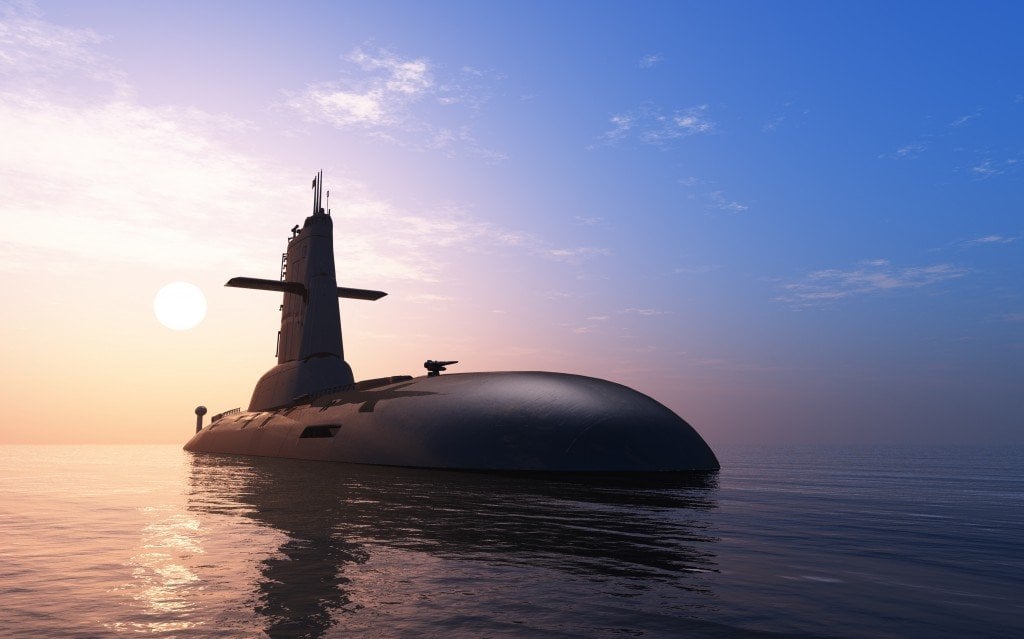
Submarine
A formidable underwater machine

How does a submarine dive and resurface?

Before we discuss how submarines break the surface and go underwater, let’s do a quick recap of an important physical phenomenon of water that you surely studied at some point in a science class: buoyancy.
Buoyancy is basically an upward force that keeps everything from wooden planks to gigantic vessels from sinking. While messing with this force can have disastrous consequences, the ability to control it can be highly advantageous.
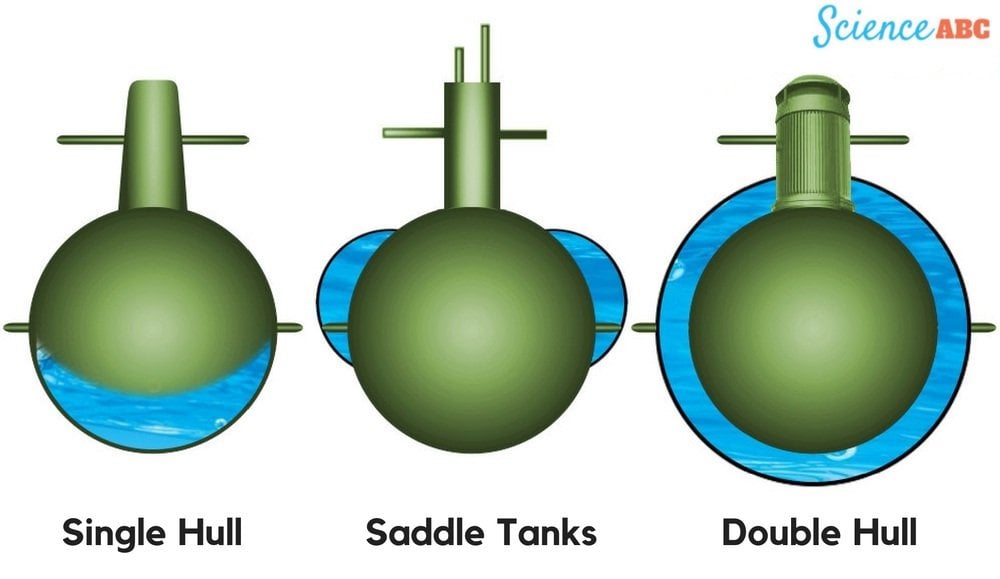
If the weight of water displaced by an object is equal to its own weight, then it floats; otherwise, it sinks. While most boats and vessels don’t dare to mess with this equilibrium, since it keeps them afloat, submarines manipulate this effect on purpose. In order to control the buoyant force acting on it, a submarine fills/empties itself with the surrounding water to dive/resurface. A submarine consists of ballast tanks (and trim tanks too, in some models) that can be filled by either water or air according to navigational requirements.
Ballast tanks are located at different positions in different models of submarines  Ballast tanks are located at different positions on different models of submarines
It works like this: when the submarine is above the surface of the water, the ballast tanks are filled with air, which means that the overall density of the submarine is less than the water it displaces. However, when the submarine needs to dive, it releases a vent in the ballast tanks that causes the surrounding water to rush in. The crew allows the surrounding water to fill the tank until the desired depth is reached, after which the valve is closed to stop any more water from rushing in.
Submarine diving resurfacing
Ballast tanks are alternatively filled with water and compressed gas to submerge and resurface a submarine
In addition to the flooding of the tanks, two ‘diving planes’ also aid in controlling the speed of descent for the submarine. The angle of these ‘wings’ directly influences the speed of the dive.
Submarine diving underwater
Notice the orientation of diving planes as the submarine descends
On the other hand, when a submarine has to resurface, compressed air is blown into the ballast tanks from air flasks, which pushes the water out of the tanks at a rapid rate. This results in a decrease in the overall density of the submarine, causing it to rise to the surface. Furthermore, the hydroplanes are angled in such a way that water moves over the stern, pushing it down and making the submarine ascend faster.

Making turns underwater

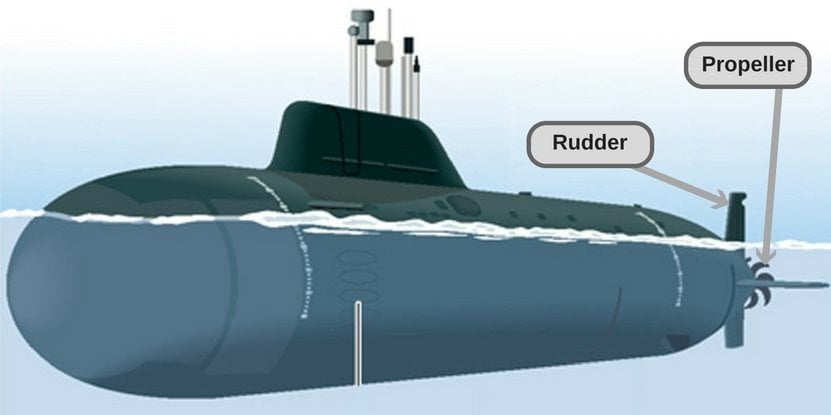
Once you’ve acquired a cruising depth, you want to ensure that the submarine moves while staying submerged at the same depth without losing/gaining any further depth. To do this, the level of water and air present in the ballast tanks must be balanced. The tail rudder can be controlled to turn starboard/port (right/left), while the hydroplanes are used to control the fore-aft angle.
Submarine parts Rudder and Propeller
The tail rudder helps to maneuver turns underwater
Submarines are a formidable piece of engineering, in that they not only operate under incredibly high-pressure conditions hundreds of meters underwater, but also keep nations’ maritime borders protected from intruders and facilitate scientific research beneath the waves.

Thursday, 19 May 2016

What is the Shape of the Universe?

When you stare up at the stars from an empty field, or from the top of a mountain, well away from the light pollution of cities and roads, it is truly a marvelous sight. The stars seem to form a heavenly dome above your head, twinkling down at you from the massive, endless expanse of space.
In our explorations of outer space, we have made some amazing discoveries – black holes, dark matter, galaxies containing hundreds of billions of stars, and spectacular nebulae. We can place all of these celestial objects in a relative “map” in relation to our planet, but try thinking outside the box a bit….
Think beyond our planet, solar system, galaxy, and even the universe. Imagine stepping outside of the universe and peering down like some sort of extra-universal super-being. The million-dollar question, of course, is….what would you see? What is the shape of the universe?

Mind-Boggling and Fascinating

It can be difficult for human beings to conceive the vastness of space. At a certain point, the massive distance and scope of the term “infinite” become too great; a relative perspective becomes almost impossible. Furthermore, that confusion happens when we are still discussing things within our universe, let alone when considering the idea of stepping outside of it! Fortunately, there are a number of scientists who enjoy stretching their brains to those incredible proportions, and while we don’t have a definite answer to this head-scratching question, we do have a few possible answers…
tzq1s

Einstein… As Always

Whenever theories or debates about space arise, it seems like Albert Einstein’s name inevitably pops up, and this particular question is no different. To understand the shape of the universe, we need to dip our toes into Einstein’s theory of general relativity. If you think you already understand it well enough, this is what that German genius has to say…
In extremely simple terms, Einstein posited that space, time, mass, and energy were inextricably linked. He argued that gravity can bend light, affect time, and even determine the shape of space itself. Gravity is generated by objects with mass, so the next logical step in that argument is that mass can change the curve of space.
Since the universe, as we know it, is filled with celestial objects and bodies that possess mass, space also has a density (the amount of mass spread over the amount of volume). The important factor here is “critical density”, which is the point where the universe is said to be “balanced”. This critical point is calculated based on the expansion rate of the universe.
Now, when the Big Bang occurred, and for the approximately 14 billion years since then, the universe has been expanding rapidly (some even say it’s speeding up!). Scientists have observed that everything in space appears to be flying away from everything else (on a grand scale). The great question of our modern astronomical age is whether that expansion is going to continue, stop, or reverse.
Expanding Universe
Credits:Designua/Shutterstock
That is precisely where this discussion of the universe’s shape gets interesting.

Our Three Possible Universes

So, now we know that we have a “critical density” of the universe, but what about the actual density (calculated based on mass and volume)? Well, since we can only observe roughly 14 billion light years in any direction from an observable point, scientists have a rather good idea of the “observable universe”, but that means we only know the volume and the estimated mass of the observable universe. Hence, the uncertainty, and the three following possibilities…
tzqo8
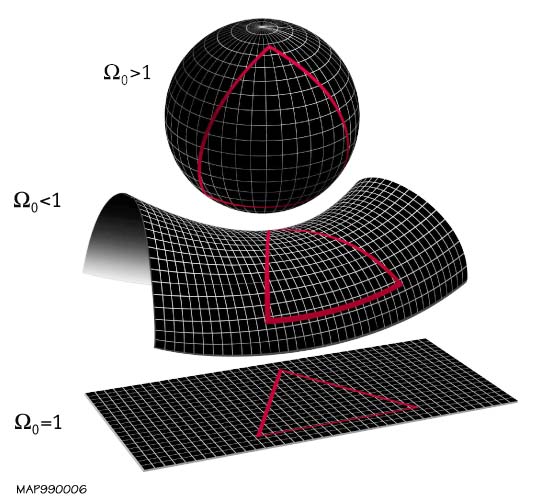
Option 1: Actual Density Greater than Critical Density – In this scenario, the shape of the universe is a perfect sphere. Essentially, the universe contains enough mass to eventually stop the expansion, which has been moving outwards from the point of the Big Bang. This version is called a “closed universe”, with no beginning or end (a sphere). Eventually, the expansion will reverse, and we will experience the opposite of the Big Bang, with the entire universe compressing in on itself. This uncomfortable fate is popularly called “The Big Crunch”.
Option 2: Actual Density Less than Critical Density – In this scenario, the shape of the universe is the same as a saddle, or a hyperbolic form (in geometric terms). Here, the universe doesn’t have enough mass to stop the expansion, and it will continue expanding outwards forever. This version is called an “open universe”.
Option 3: Actual Density Equals Critical Density – In this scenario, the shape of the universe is completely flat and infinite. While this seems like the least likely (that the two densities are just perfectly balanced), this is actually the most popularly assumed theory in scientific circles. The expansion will slow down gradually, perhaps over tens or hundreds of billions of years, until a stasis point is achieved, but there will be no great contraction or “Crunch”.
Shape of Universe
Shape of Universe where Ω is the density parameter (Credits:NASA/Wikipedia)

What Does This Mean for Us?

While it’s a lot of fun to think of our role in the grand cosmic displays above our heads, the truth is, the shape of the universe and the various density measurements discussed above will never affect our lives. Again, it is difficult to comprehend the scale of light years and the universe, and it is almost impossible to conceive billions of years. Whether we end up stretched out into an icy, infinite, frozen universe, or crunched back down into a singularity, we certainly won’t be around to see it. We can guess at the answers, but we are still limited by the observable universe and mystified by the hundreds of other unexplained phenomena and anomalies of the cosmos.
However, if we could step outside of the universe and look down at its shape (whatever it happens to be), it would certainly be a glorious sight!

How Can We Create Artificial Gravity?

Gravity is one of the fundamental forces of the universe. It defines the world as we know it by binding the cosmos together. Without gravity, everything would constantly move away from everything else. It’s such a basic building block of physics that we often take it for granted. It’s frightening to think about what would happen if someone just simply turned Earth’s metaphorical gravity switch off. We would be flung off the surface of the earth into space due to inertia of the Earth’s rotational motion. If we turned the Sun’s gravity off, there would be nothing holding the solar system together. We’d witness chaos on an incredible scale with planets colliding into each other and meteors raining down on us like a storm of destruction.
13s8mk
However, as essential as gravity is, there are some scenarios in which some degree of control over it would be tremendously useful. Imagine flying without airplanes or transporting heavy objects with almost no effort. Astronauts currently experience many physiological changes during weightless space travel, and most of these changes affect them negatively. They suffer from muscular dystrophy, bone mass loss, disorientation and other zero-g effects. Therefore, interstellar travel would be much easier if gravity could be synthesized artificially. What goes up must come down, right? Is that a fact? The bigger you are, the harder you fall? Truth or fiction? 
Now, let’s see how close we are to actually harnessing the force of gravity.

Defining Gravity

Gravity is the force of attraction that two objects exert on each other. The magnitude of this force increases as the bodies become more massive, and decreases if the bodies move further away from each other. Also, gravitational force always acts in a direction that tries to bring the two objects closer together. Ultimately, gravity is a force that can only bring two objects together, not drive them apart. It doesn’t require the two objects to be in actual contact and is always active (varied in magnitude) for each and every pair of objects in the universe without exception.
13s8oh

How to simulate gravity?

Rotation: Travel in a rotating Spaceship

Gravity, by definition, is a force of attraction, but there are other ways in which two bodies move towards each other. One of these ways could be using a rotating spacecraft, which would induce conditions that are normally observed in a centrifuge.
Endurance-0
The rotation would drive any object inside the spacecraft towards the base and away from the center of rotation. The resistive force from the base of the hull would act like the normal force exerted on us by the Earth’s surface while standing. The centrifugal force pushing us towards the base of the hull would act like the gravitational force that the Earth exerts on us.
However, there is one caveat. In this system, the artificial levels vary greatly based on the distance from the center of rotation. Hence, the artificial gravity experienced at the head would be greater than that at the legs. This could make movement and changing body position awkward. However, this effect could be reduced if the radius of the ship was kept much larger than the height of an average person.
Linear Acceleration: Travel in a Space Roller Coaster
An increase in speed, i.e. acceleration, is brought about due to gravity. This is the main reason why, when we free fall, our speed increases. This acceleration can be simulated in the form of an accelerating spacecraft. A spacecraft under constant acceleration in a straight line would give the appearance of gravitational pull in the opposite direction. This would cause the object being accelerated to experience a force pulling it backwards. If you’re wondering how comfortable it would be in a constant state of acceleration, don’t worry, because that’s what you experience all the time due the Earth’s gravitational pull, roller coasters and sports cars. Also, the body won’t know that it’s moving if there is no acceleration. Think about it… the Earth rotates at about 1700 kilometers per hour at the Equator, but we don’t feel it because this speed is constant and there is no acceleration.
why-cant-we-get-a-melbourne-sydney-bullet-train-1425438379-crop_desktop
Linear acceleration in space travel would require huge amounts of rocket fuel, whereas the rotation strategy doesn’t need any continuous application of force. Nevertheless, constant linear acceleration is desirable, since in addition to providing artificial gravity, it could theoretically provide relatively short flight times around the solar system.
millenniumforce02wide
Magnetism:
There is a method by which the effects of gravity can be created using dia-magnetism, but it requires extremely powerful magnetic fields. With such strong magnetic fields, it is doubtful that it will ever be safe for use by humans. Experimentally, frogs and even rats have been levitated against the Earth’s gravity, but that is a very small scale. The machines using dia-magnetism to simulate gravity can be used to induce low gravity conditions safely, and the strength is similar to what one might experience in lunar or Martian gravity.
Frog_diamagnetic_levitation
Live frog levitating inside a magnetic field
Para-gravity:
Artificially simulated gravity in a spacecraft that is neither rotating nor accelerating, also known as ‘para-gravity’, has been hypothesized, but there is no confirmed technique, at present, that can simulate gravity other than mechanical or magnetic acceleration. However, Murphy from Interstellar figured it out, so how hard could it be?
Other than the above-mentioned methods, there are simpler methods to negate the effects of gravity and obtain near zero-g conditions. Those huge human centrifuges with a long rotating arm that we see in cartoons and movies are actually very useful in preparing astronauts for high-g conditions during launches.
504x_weeee
Neutral buoyancy is another technique in which people are trained to tackle low-g by performing simple tasks in the simulated environment of a swimming pool.
edu_neutral_buoyancy_large
Neutral Buoyancy is not weightlessness, since we can still sense the direction of gravity underwater, but this comes very close to approximating spaceflight conditions.
13s9ir That's What artificial gravity Is